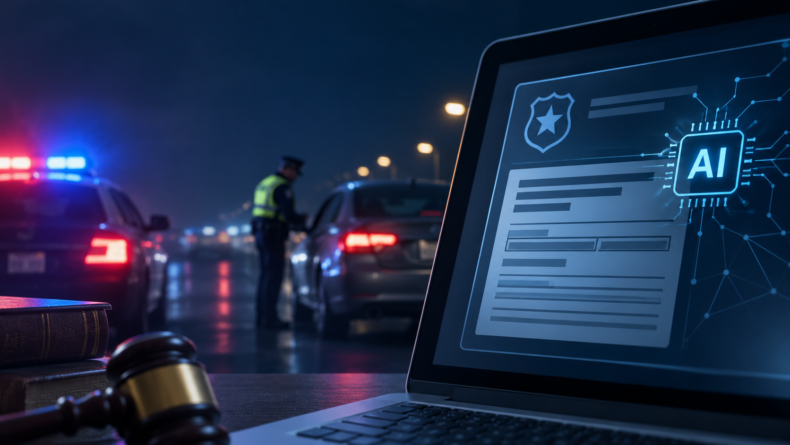
An Arizona court’s refusal to find probable cause from an AI-assisted arrest report highlights why the accuracy, authorship, and reliability of police evidence matter in criminal cases.
Artificial intelligence is changing how businesses operate, how people communicate, and increasingly, how law enforcement documents criminal investigations. But what happens when the technology becomes part of the evidence used to justify an arrest?
A recent DUI case in Arizona has brought that question into focus.
On October 29, 2026, Arizona Department of Public Safety troopers arrested 37-year-old Anthony Edward Rene Quidera after a trooper allegedly observed his vehicle traveling more than 100 miles per hour on Interstate 10 near Phoenix. The arrest report described signs of possible impairment, including the odor of alcohol, and alleged that open containers were found in the vehicle.
But when the case reached an initial hearing, the court examined not only the allegations but also how the report had been prepared.
The Problem Wasn’t Just What the Report Said
The trooper’s probable cause narrative included a disclosure that it had been generated with assistance from Truleo AI, a report-writing tool. The disclosure also said that its content reflected the officer’s observations and recollections.
Maricopa County Superior Court Commissioner Daniel Fenzel questioned whether the court could meaningfully distinguish the officer’s own factual allegations from language generated by AI. Without further information about how the narrative was created, the court said it could not determine probable cause at that time and ordered Quidera released.
That decision did not establish innocence or automatically end the DUI case. The court expressly left open the possibility of further proceedings. The distinction matters: a decision concerning custody and probable cause at an initial appearance is not the same as an acquittal.
The incident was reported by ABC15 Arizona and ABC News.
Why Probable Cause Matters in Pennsylvania DUI Cases
For someone facing DUI charges in Delaware County or Montgomery County, probable cause is more than a technical term. It is part of the legal framework governing arrests and certain searches.
In Pennsylvania, the justification for a traffic stop, the grounds for an arrest, and the reliability of evidence obtained during the investigation can all become important issues in a DUI defense.
Officers may describe driving behavior, physical signs of impairment, statements, or performance during field sobriety testing. Those descriptions should be evaluated in context and, where available, compared with recordings and other evidence.
Can Artificial Intelligence Introduce Errors Into Police Evidence?
AI can organize information and help produce readable summaries. It can also make mistakes, leave out details, or phrase an inference as though it were an established observation. That does not mean every AI-assisted report is unreliable, or that such reports are automatically inadmissible.
It does mean that transparency about how a report was prepared can matter when its accuracy is challenged. Body camera footage, dashcam recordings, contemporaneous notes, laboratory results, and officer testimony may help establish what actually occurred.
Arizona DPS told ABC News that troopers remain responsible for the accuracy and completeness of their reports and are required to review drafts against available evidence. The Arizona ruling concerned the information presented to that particular court, not a general prohibition on AI writing assistance.
What a Delaware County DUI Lawyer May Examine
A careful DUI defense looks beyond the arrest report. Depending on the facts, relevant questions may include whether the traffic stop was lawful, what evidence supported probable cause, whether tests were administered appropriately, and whether video or other records support the written account.
At Latoison Law, criminal defense work includes reviewing the evidence and procedures involved in an arrest. People seeking a DUI lawyer in Delaware County can learn more about the firm’s representation for DUI charges and related criminal matters.
The Arizona decision is not binding precedent in Pennsylvania. Still, it illustrates a fundamental concern that applies in every jurisdiction: a criminal allegation should be supported by evidence that can be evaluated, rather than accepted merely because it appears in an official report.
Facing DUI Charges in Delaware County or Montgomery County?
A DUI arrest does not eliminate your right to question the evidence or challenge the legality of police procedures. The circumstances of the stop, arrest, and testing can affect the options available in a Pennsylvania criminal case.
Latoison Law provides criminal defense representation from Media, Pennsylvania, serving Delaware County, Montgomery County, and surrounding communities.
Call Latoison Law at 610-999-1439 to discuss your DUI charges and learn about your legal options.
Sources: ABC15 Arizona and ABC News, November 2026. This article discusses an Arizona court decision and is intended for general information, not legal advice. The outcome of any Pennsylvania DUI case depends on its particular facts and applicable law.